
Crane County Criminal History Checks
No single system holds the whole record. Start with the office that created the part you need. The combined Crane County and District Clerk holds filed felony and county misdemeanor cases. Crane Municipal Court and the countywide Justice Court keep their own fine-only matters. The sheriff handles present county custody and booking questions, while the Texas Department of Public Safety compiles criminal-history data reported by Texas agencies.
Gather a full legal name, date of birth, prior names, a case or citation number when known, and an approximate event year. Those facts help separate people with similar names. The official DPS Criminal History Search provides the public statewide slice, while the local clerk supplies the court docket and disposition.
- Identify whether the event was a city citation, county citation, misdemeanor, felony, booking, or state-prison placement.
- Ask the proper court for filed charges, orders, and the final disposition.
- Call the sheriff for current custody or booking details that are not posted online.
- Run the DPS name search for reported Texas convictions and deferred adjudications.
- Order a certified court disposition when official proof or a DPS correction is needed.
The DPS Crime Records hub shows how the state separates its criminal-history, fingerprint, and registration services.
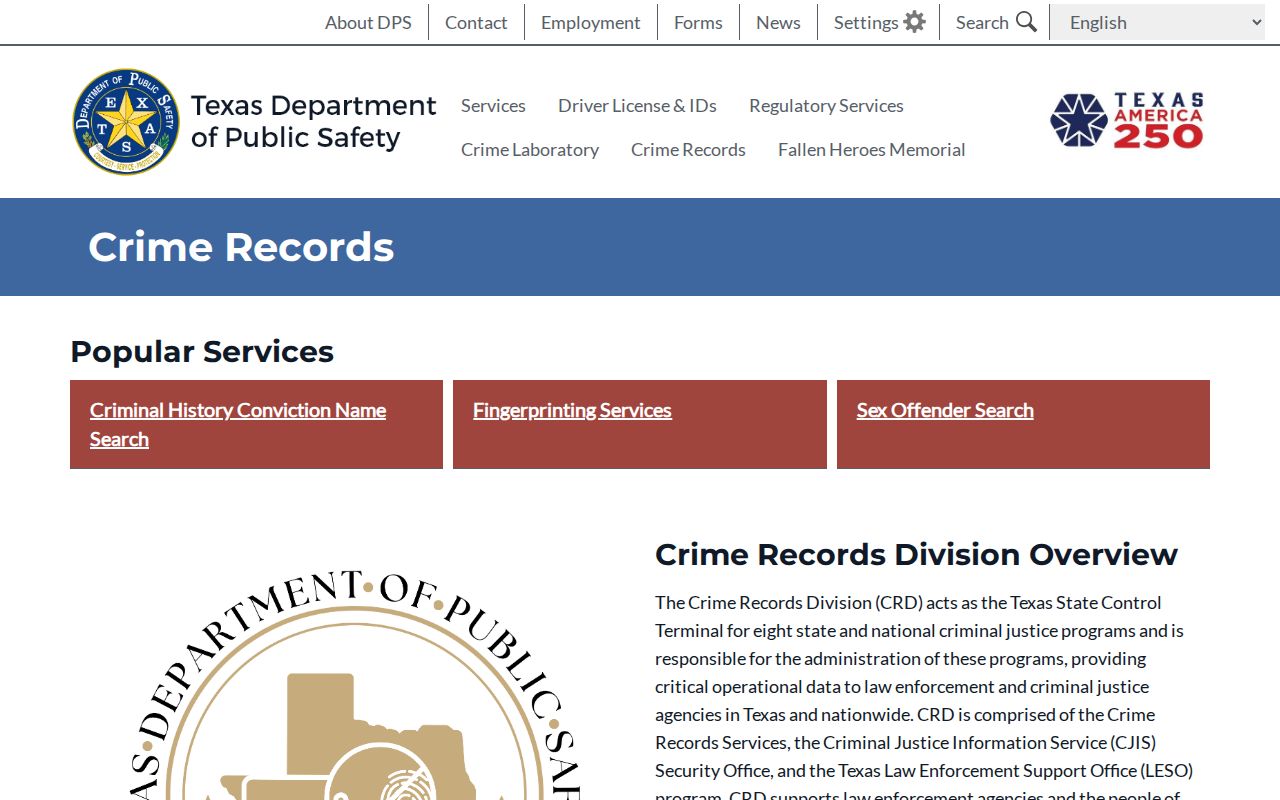
That service map helps a Crane County searcher choose an official state product instead of assuming one search covers all local records.
Crane County Records at Room 110
Crane County concentrates two criminal dockets at one counter. Combined County and District Clerk Andrea Flores is listed in Room 110 of the Crane County Courthouse, 201 W. 6th Street, Crane, TX 79731. Mail goes to P.O. Box 578. The office phone is 432-558-3581, the fax is 432-558-1148, and the confirmed email is coclerk@co.crane.tx.us. State felony files belong to the district side. County Court filings, chiefly Class A and B misdemeanors, belong to the county side.
County and District Clerk
201 W. 6th Street, Room 110
Crane, TX 79731
432-558-3581
coclerk@co.crane.tx.us
Crane County Sheriff
P.O. Box 1175
Crane, TX 79731
432-558-3571
Fax 432-558-3743
Crane Police Department
115 W. 6th Street
Crane, TX 79731
432-558-2212
cranepd@crane.texas.gov
County pages disagree about the midday clerk schedule. One shows a 12:00 to 12:30 p.m. closure, while another does not. Monetary transactions stop at 4:30 p.m. Monday through Thursday and 3:30 p.m. Friday. Call before a lunch-hour trip.
Official Background Checks in Texas
The DPS public name product returns reported convictions and deferred adjudications. An online query costs one $1 search credit. Credit card purchases add 2.25 percent per credit plus $0.25 per order. A mailed CR-42 request costs $10. Name and birth-date matching can yield a false match or miss an event, so it is not the same as a fingerprint-confirmed personal review.
The DPS search instructions explain accounts, credits, name expansion, and result retention.

The instructions matter when a common name creates several candidate matches. Use a full date of birth and review why each result matched.
For the most accurate review of one's own Texas record, DPS uses Fingerprint Applicant Services of Texas with electronic capture through IdentoGO by IDEMIA. DPS lists a $15 record-check fee plus a $10 FAST capture fee. The person schedules with a service code, valid ID, and payment. This fingerprint route verifies identity in a way a name query cannot.
Crane County Jail Record Chain
Crane County does not publish an official jail roster, daily booking log, or inmate search. The official sheriff page instead routes users to VINELink. For present custody, call the Sheriff's Office at 432-558-3571 and ask about booking, bond, transfer, or release. Use VINELink for custody status and notification. If the needed booking material is not given by phone, submit a focused written request to the sheriff.
After a prosecutor files a case, check with the combined clerk. A person later sent to state prison belongs in the TDCJ Online Inmate Search, not a county jail list. The Texas Commission on Jail Standards identifies a rated local capacity of 24, Sheriff Andrew Aguilar, Jail Administrator Sergio Sifuentez, current compliance, and no remedial order. It has also described planning for a replacement facility. None of those facts creates a public roster.
Search caution: A third-party page using the county name is not an official Crane County jail source. Confirm custody through the sheriff or VINELink.
Kinds of Criminal Records
Criminal records in Crane County differ by creator and stage. A police report states what an agency investigated. A booking file records intake and custody. A prosecutor decides what charge to file. The clerk records pleadings, settings, orders, judgment, and sentence. DPS then compiles reportable state events submitted by law enforcement, prosecutors, courts, clerks, and probation offices.
- Incident and arrest reports: held first by the sheriff, Crane Police Department, or other arresting agency.
- Booking and custody files: held by the county jail or later by TDCJ after a state-prison transfer.
- Court case records: divided among Municipal, Justice, County, and 109th District courts.
- Warrants: issued through courts and checked with the issuing court or executing agency.
- CCH and registration records: compiled by DPS from agency reports under distinct access laws.
The DPS public-site entry is the state gateway for members of the public who do not qualify for restricted access.
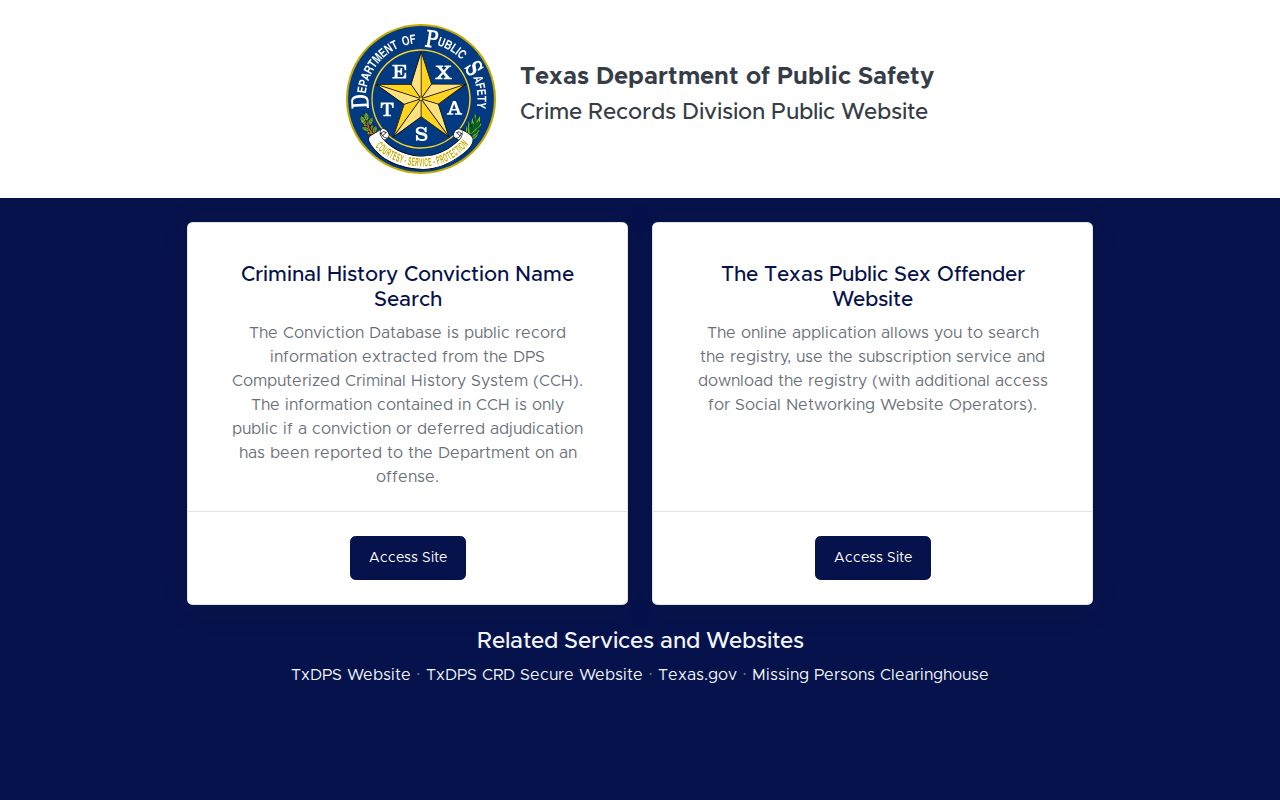
Its role is narrower than the local record chain. A public CCH result should be checked against the court that entered the outcome.
Crane County Criminal Record Flow
A Crane arrest can create several records with different numbers. The arresting agency writes the incident or arrest report. Jail staff create booking data and capture a photo and fingerprints for a qualifying custodial arrest. The fingerprint transaction provides the positive identifier used to connect later prosecution and disposition data. Under Texas reporting rules, Class B misdemeanor and more serious cycles move into CCH reporting.
Local research gives an unusually clear view. A DPS Crane County improvement plan says Crane Police worked with the sheriff because the sheriff had LiveScan. It described CR-43 reporting with fingerprints and a separate CR-43J route for juveniles. Prosecutors, courts, clerks, and community-supervision offices then add later events. The flow is: Arresting agency → Sheriff LiveScan and booking → Prosecutor → Crane court and clerk → DPS CCH.
The DPS Criminal History Reporting page describes the statewide training and submission process behind that chain.
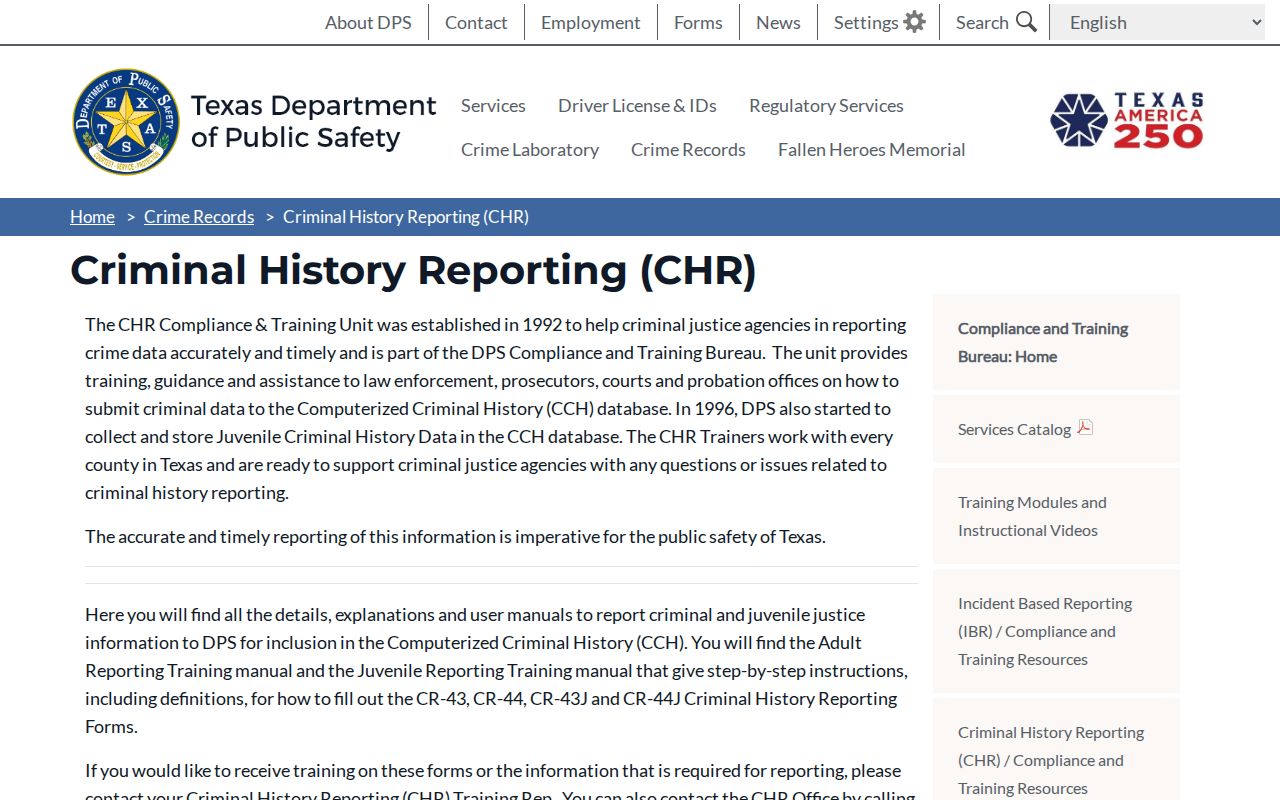
Reporting can lag. A missing disposition in DPS does not erase the court's judgment, and a local file may exist even when the statewide result is blank.
Crane County Criminal Records: What They Contain
A Texas CCH links an arrest cycle with prosecution and disposition details. A local file can hold more documents than the public DPS product. Read each field in context, since an arrest charge can differ from the prosecutor's filed charge and a filed charge can end in dismissal or acquittal.
| Name & identifiers | Legal name, aliases, demographic descriptors, SID, and transaction identifiers where available. |
|---|---|
| Arrest / booking data | Agency, date, initial allegation, booking identifier, and custody events in the creating office's file. |
| Charges & court | Arrest charge, prosecution charge, court level, case number, and charging instrument. |
| Disposition | Outcome such as conviction, dismissal, acquittal, or deferred adjudication. |
| Sentence | Court-ordered punishment, fine, confinement, or community supervision when applicable. |
| Custody / supervision | Jail or prison placement, release status, probation, parole, or mandatory supervision within access limits. |
- Disposition
- The recorded outcome of a case, not merely the charge alleged at arrest.
- Deferred adjudication
- Supervision while a finding of guilt is postponed; completion does not erase the record by itself.
- Community supervision
- The Texas legal term commonly called probation.
- Nondisclosure
- An order that limits public release of specified history without destroying every record.
Ask the Crane County clerk for the docket and final judgment when a short search result does not make the outcome clear.
Crane County Warrant Record Checks
No official county warrant list, name database, most-wanted page, or mobile app was found. Check the office tied to the possible warrant. The sheriff handles county or district execution questions at 432-558-3571. Crane Police handles city police matters at 432-558-2212. Municipal Court answers city Class C, traffic, ordinance, failure-to-appear, and capias questions at 432-558-7747.
The countywide Justice Court can confirm JP matters at 432-558-1108. The combined clerk can check warrant-related entries in felony and County Court files at 432-558-3581. The JP vendor page is a payment service, not a warrant search. A person resolving their own possible warrant should ask the issuing court about appearance, bond, counsel, or payment steps. Paying an unrelated balance does not prove that a warrant has cleared.
Note: Unexecuted, sealed, and juvenile warrants may be withheld, and a web result may lag behind the issuing court's current record.
Texas Public Access Laws
Texas law opens some criminal-history material while protecting other parts. Government Code Chapter 411 permits DPS to release public criminal-history information made up chiefly of reported convictions and deferred adjudications. It does not make the full fingerprint-linked CCH public. The Texas Public Information Act offers a way to inspect or copy government records, but confidentiality statutes and law-enforcement exceptions still apply. Judicial records may follow court rules and clerk procedures instead of the executive-branch request process.
Key Texas laws:
Government Code Chapter 411 controls DPS criminal-history access and nondisclosure.
Government Code Chapter 552 is the Texas Public Information Act.
Code of Criminal Procedure Chapter 66 governs reporting of arrest, prosecution, and disposition data.
Code of Criminal Procedure Chapter 55 sets the Texas expunction framework.
Code of Criminal Procedure Chapter 62 governs sex-offender registration and notice.
The official Chapter 552 text supplies the law behind public-information requests.
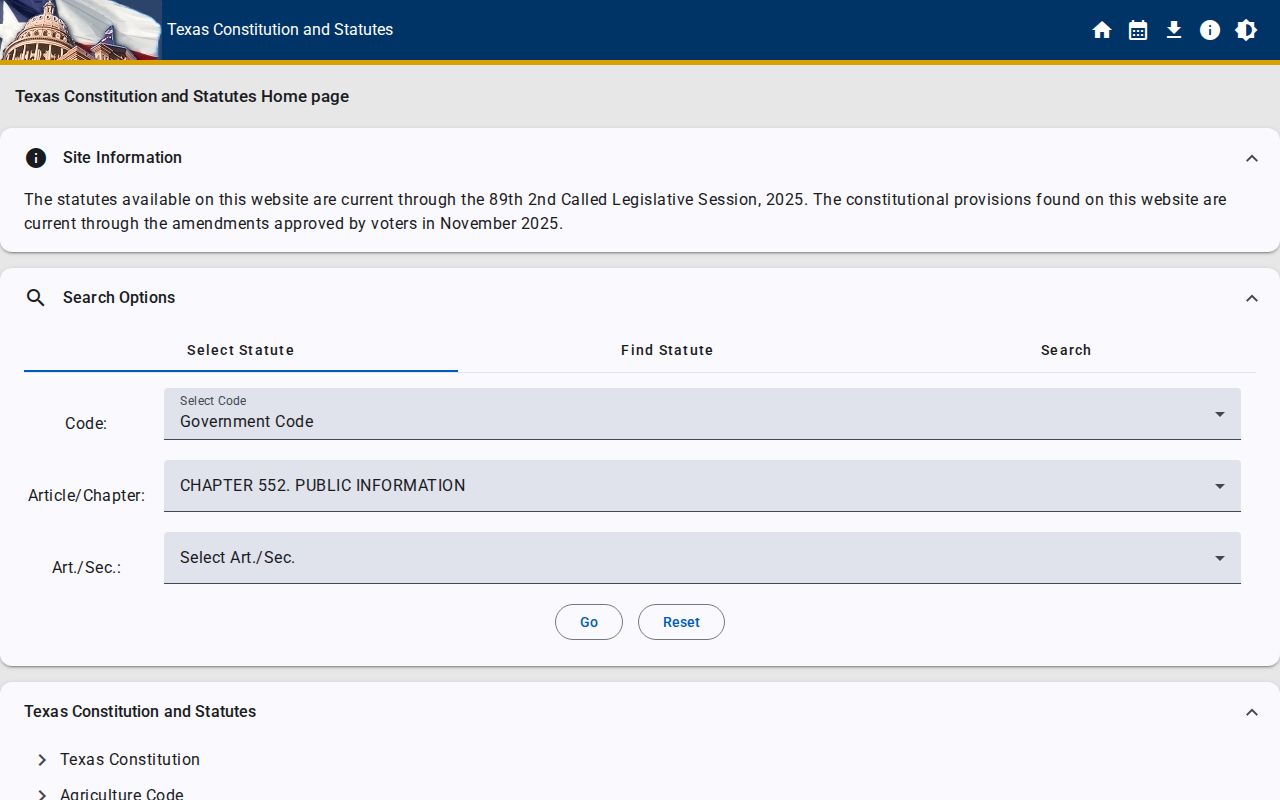
That law is a request path, not a promise that every police, juvenile, sealed, or court record must be released.
Crane County Record Copy Fees
The clerk's fee schedule took effect January 1, 2024, so confirm the amount before a large order. The office also publishes a request form aimed mainly at recorded documents. Its grantee, instrument, volume, and page fields show why it should not be treated as a sheriff arrest-report form. For a criminal court file, give the court level, case number, party name, and approximate filing year. Ask whether the file is active, archived, on paper, or available by mail.
| Clerk service | Posted amount |
|---|---|
| Ordinary copy | $1 per page |
| Certified copy | $1 per page plus $5 per document |
| Authenticated certification | $10 |
| Weekly or monthly CD | $15 |
| Clerk search, to a certain extent | $5 |
A credit card convenience fee is noted but not stated. The clerk will not perform a complicated search and provides public viewing stations and record books for self-searching.
Restricted, Sealed & Expunged Records
Expunction is the Texas removal or destruction remedy for eligible arrest-related records. An order of nondisclosure limits ordinary public release of specified criminal-history information but does not destroy the record or block every authorized government user. Juvenile history, sealed material, and protected data follow separate limits. Eligibility depends on the arrest, charge, final result, waiting rules, and whether another charge arose from the same criminal episode.
Official Texas court forms organize nondisclosure routes by statute. Common expunction paths can include acquittal, pardon, qualifying dismissal, successful pretrial diversion, or a release that meets the detailed no-conviction and waiting rules. The published no-indictment or information waits include 180 days for a Class C arrest, one year for Class A or B, and three years for a felony, but a wait alone does not establish eligibility.
The DPS general information page connects personal review with official CCH resources.
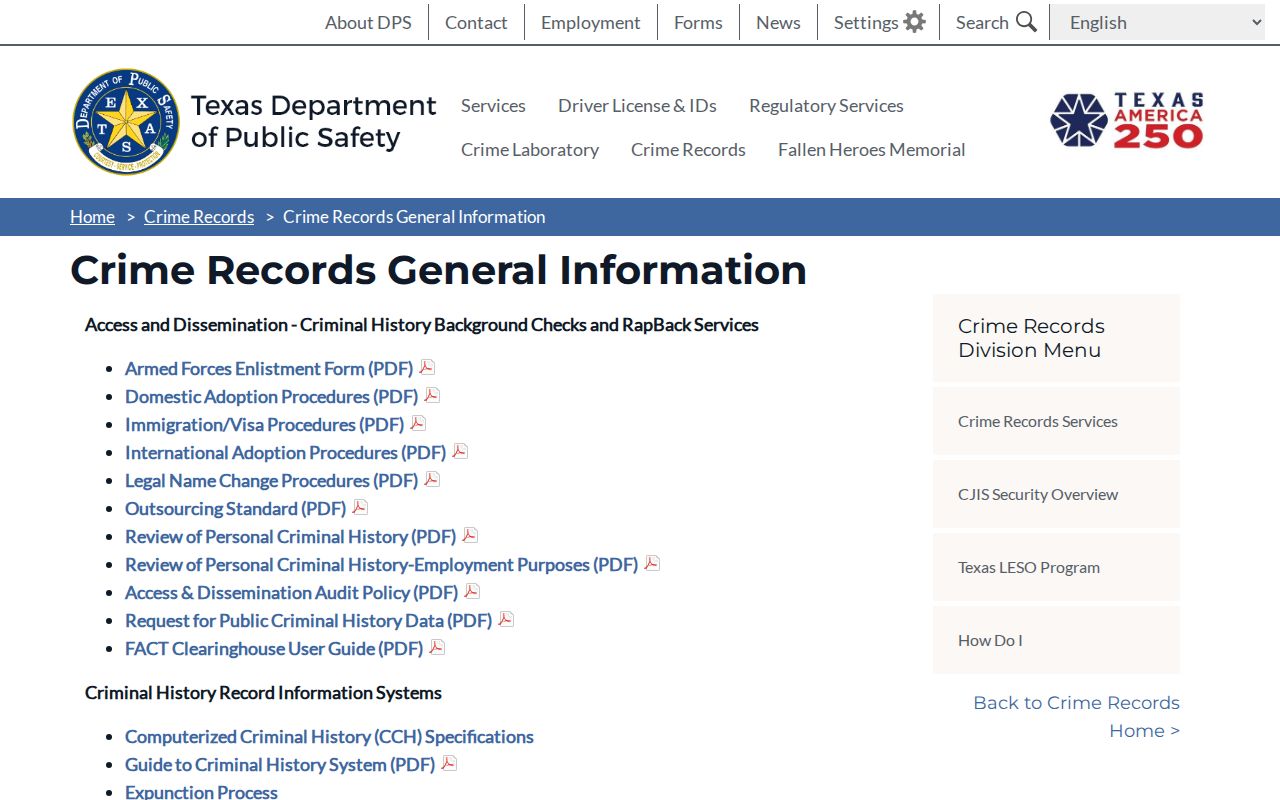
Review the current record before seeking relief. A wrong or missing disposition calls for correction, which is distinct from expunction.
Crane County Arrest Record Differences
An arrest, booking, court case, and rap sheet describe different stages. Crane Police or the sheriff records the event and alleged conduct. Jail booking marks custody. A prosecutor may change, reject, enhance, or dismiss the initial charge. The clerk's docket then records the filed case and outcome. DPS receives reportable events from those agencies, but its public name product remains narrower than the complete local chain.
| Record | Best Crane County source | What it answers |
|---|---|---|
| Incident or arrest report | Creating police agency | What the agency investigated and alleged |
| Booking record | Crane County Sheriff | Intake, custody, bond, release, or transfer |
| Court case | Proper clerk or court | Filed charge, orders, disposition, and sentence |
| Public CCH | Texas DPS | Reported convictions and deferred adjudications |
The DPS Error Resolution page explains how to challenge incomplete or inaccurate state history.
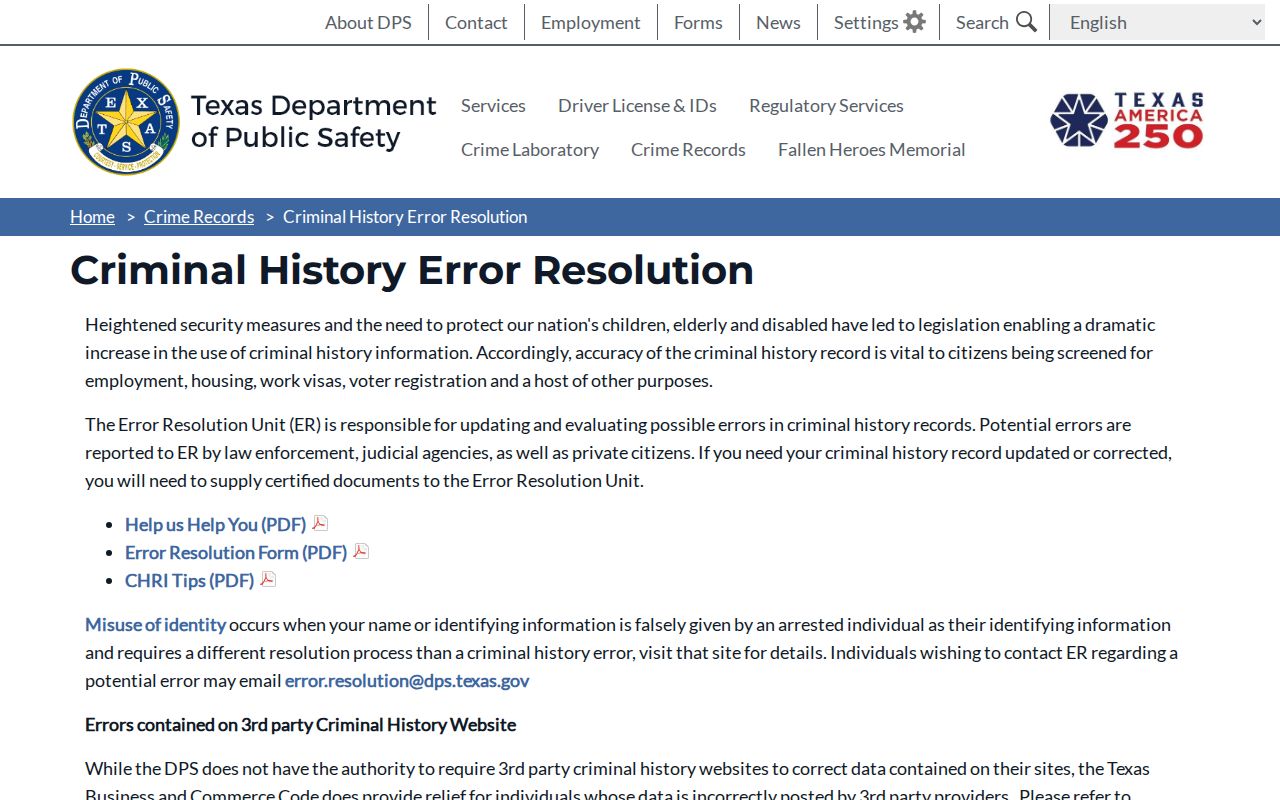
DPS requires a certified disposition from the court of jurisdiction to fix missing court information. An ordinary unsealed copy is not enough.
Crane County Custody Record Choices
County jail custody, state prison, parole, and community supervision are separate. The sheriff and VINELink cover current county custody. TDCJ's locator covers people sentenced to Texas prison and can show location, offenses, and projected release details. The Texas Board of Pardons and Paroles makes release decisions, while the TDCJ Parole Division supervises parole and mandatory supervision. A local or regional Community Supervision and Corrections Department handles the Texas form of probation.
Absence from the TDCJ locator does not mean a person has no Crane County case or probation. Check the sentencing court for the judgment, sentence, and any motion to revoke or adjudicate. Detailed supervision files may contain confidential medical, social, investigative, and officer work material. Public court orders and the full supervision case file are not the same product.
For one's own broader federal review, the FBI Identity History Summary is fingerprint based and costs $18. It is not a public name search or a substitute for a Crane County court file.
Crane County Courthouse Record History
Crane County's small scale shapes access. The Census Bureau estimated 4,554 residents in 2025 across 785.07 square miles of land. The county has one incorporated city. That sparse geography helps explain why the clerk, county court work, Justice Court contact, and local district proceedings cluster around one courthouse instead of a large set of branch offices.
The county formed in 1887 and organized in 1927 after oil discovery. Its first courthouse arose that year. The present courthouse replaced it in 1948 and remains the local records hub. This history is useful in a practical way: older files may be archived, on paper, or stored in another form. Ask Room 110 about the file year, media, page count, and mail options instead of treating a blank online result as proof that no case exists.
Small counts also need care. An arrest count, case count, and conviction count measure different things. In a county with fewer than 5,000 people, a small numerical shift can create a large percentage change, so no raw figure should be called a current crime rate without a year, agency scope, and population base.
City-by-City Criminal Records in Crane County
Crane is the county seat and the only incorporated city in Crane County. Its police department creates city incident and arrest reports, while Municipal Court keeps ordinance and fine-only state-law matters within city jurisdiction. City Secretary Laura Richards processes formal city open-records requests. County jail booking, County Court cases, and 109th District felony files still require county channels, so city and county searches should not be treated as interchangeable.
Crane Record Check
3,429 residents in the January 1, 2024 state estimate · city police and municipal court record routes
The city estimate is not the county population. Searches outside Crane city limits should still include the sheriff, county courts, and statewide systems.
Crane County DPS Record Search
A DPS name search starts with an account and prepaid credit. Enter the best full name and date of birth available, then inspect the matching basis. Automated name expansions do not add search-credit charges, but they may broaden the candidate list. Save returned material within the portal's access window. If more than 15 identifier matches arise on a mailed CR-42 request, DPS asks for more detail.
The official Criminal History Search landing page is the correct state starting point.
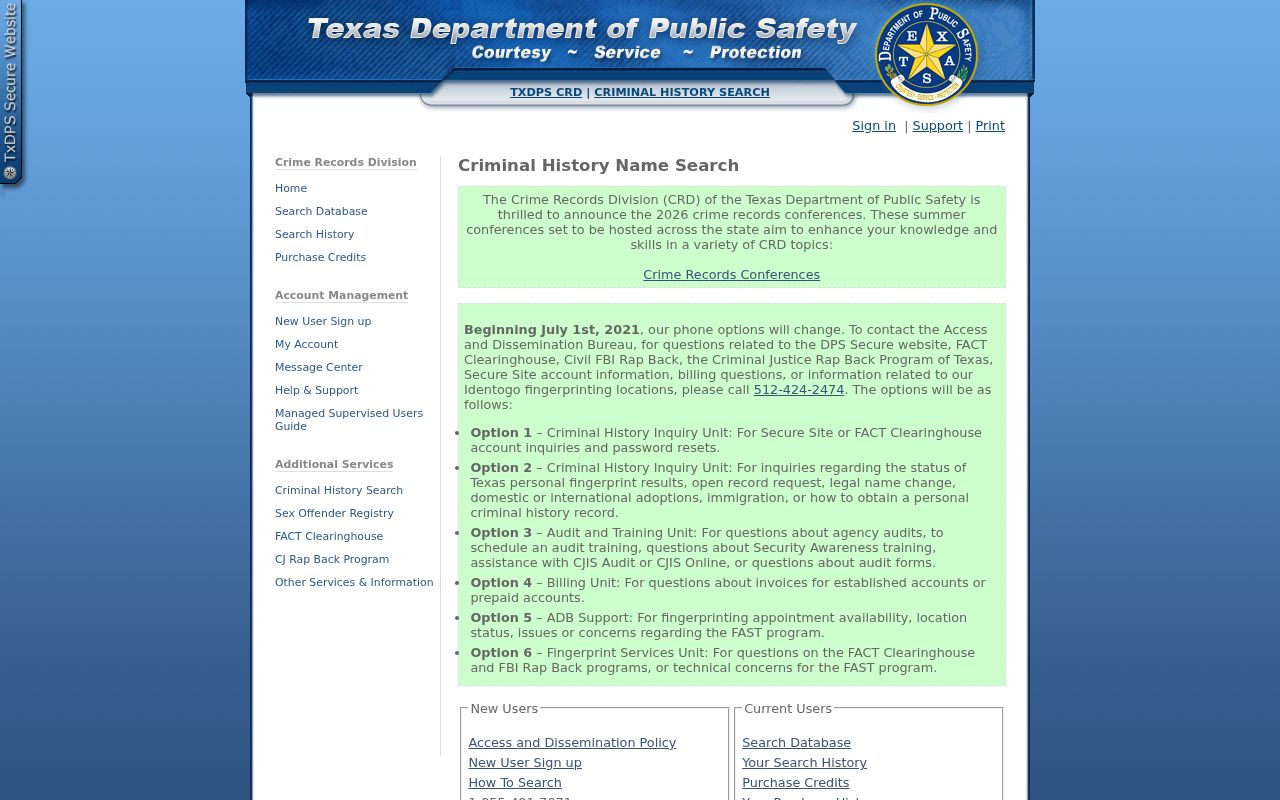
A no-record response is limited to the identifiers and reported public data searched. It cannot prove that no local court, fine-only, federal, or unreported record exists.
The Texas Attorney General's public-information overview explains prompt production and the ruling process.
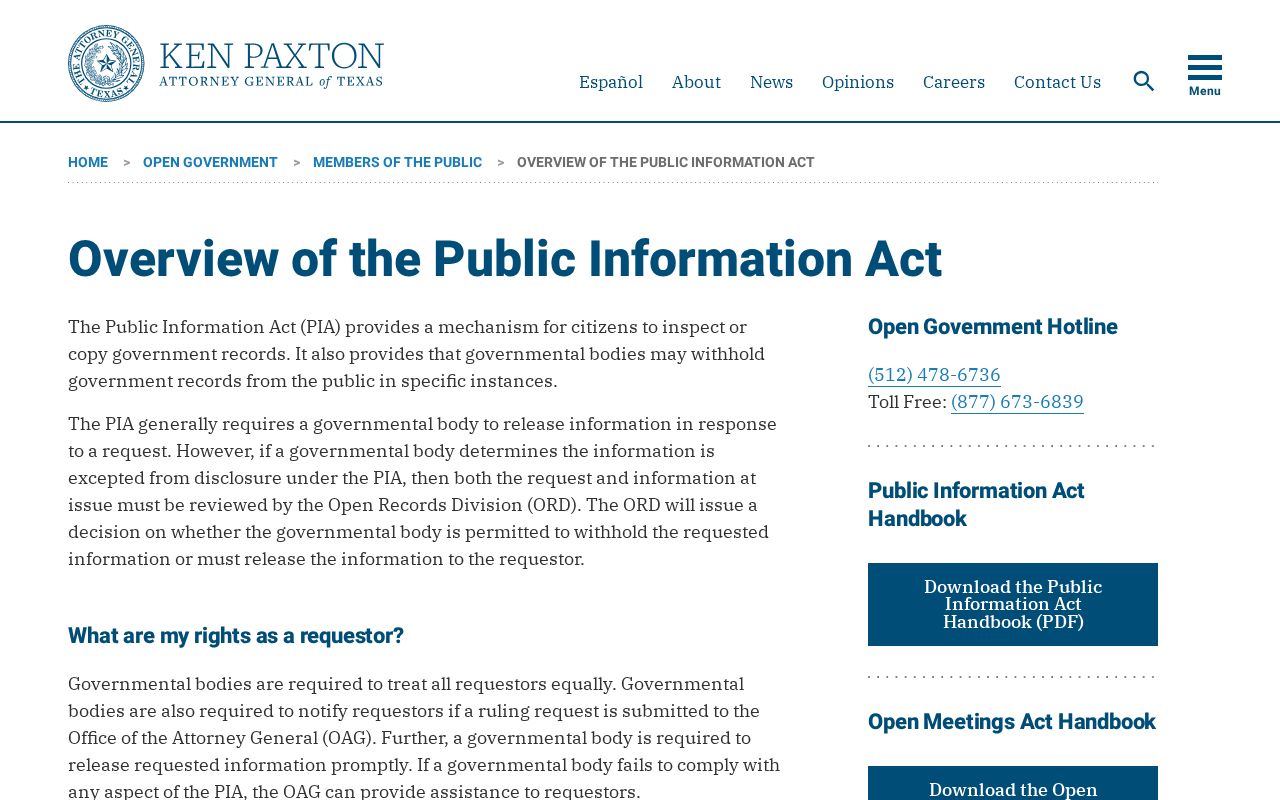
Use that process for government records subject to the Act, while asking a court clerk first about the court's own judicial-record procedure.