
Crane County Sex Offender Checks
The Texas Department of Public Safety manages the free Texas Public Sex Offender Registry. Local law enforcement registers each person, maintains the local entry, carries out required notice, and sends updates to DPS. A Crane County sex offender lookup therefore begins with the state portal but does not end there. The profile's most recent updating agency is the right contact for a suspected error or a question about current reporting.
Crane County has one incorporated city. A person who lives inside Crane reports to the city's local law-enforcement authority. A person outside a municipality reports to the county authority. Search by known identity when possible, then run place searches that account for both the city and the wide rural parts of Crane County. A single city query can miss an address beyond the municipal boundary.
The Texas DPS registration program overview explains how local registration feeds statewide public notice.
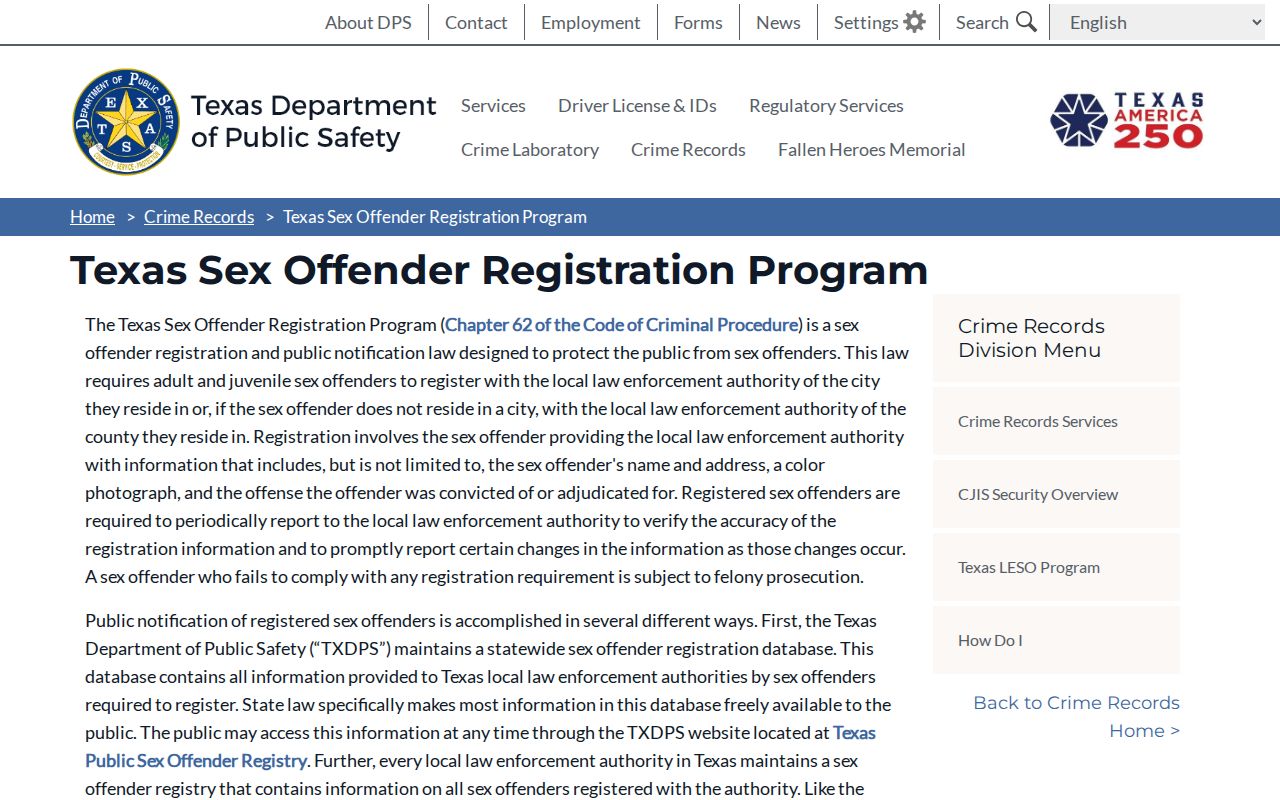
This state and local link is why Crane County registry questions should go to the agency shown as the updater, not to an unrelated court.
Crane County Registry Boundaries
Crane is both the county seat and Crane County's only incorporated city, as the official City of Crane history confirms. That makes the boundary easy to overlook. City-name results can cover addresses written as Crane while a location outside the city may fall under county registration authority. Use more than one geographic view. Try the known name, the address area, the ZIP or place controls the portal makes available, and the map route.
The Crane Police Department is at 115 W. 6th Street and answers at 432-558-2212. The Crane County Sheriff's Office lists P.O. Box 1175, Crane, TX 79731, and 432-558-3571. Neither local page publishes a separate public registry map, registry unit schedule, email alert service, or mobile app. Use the DPS portal for public searching and the correct local authority for entry-specific follow-up.
Crane Police Department
City registration authority
115 W. 6th Street
Crane, TX 79731
432-558-2212
Open 24 hours
Crane County Sheriff's Office
County registration authority
P.O. Box 1175
Crane, TX 79731
432-558-3571
Call for registration instructions
Texas Public Sex Offender Registry Searches
DPS provides name, location, and map routes through the Texas Public Sex Offender Registry. The interface is dynamic, and the research inspection timed out before every control and radius value could be verified. The fields below stay within the documented routes. They do not guess at options that could change.
- Open the official DPS registry and read its conditions of use before searching.
- Use the name route for a known person, or select the available location or map route for a Crane County area check.
- Compare the returned identity details, photo, physical description, and address so a similar name is not mistaken for the right person.
- Open the full profile and read the offense, registration, risk, and updater fields together.
| Search route | Type | Required | Best use |
|---|---|---|---|
| Name | Text search | Portal dependent | Known-person lookup with identity checks |
| Location | Place search | Portal dependent | Crane County, city, address, or ZIP area as offered |
| Map | Geographic view | No | Viewing results around a selected Crane-area location |
The official Texas search screen shows the live registry interface used for a Crane County lookup.
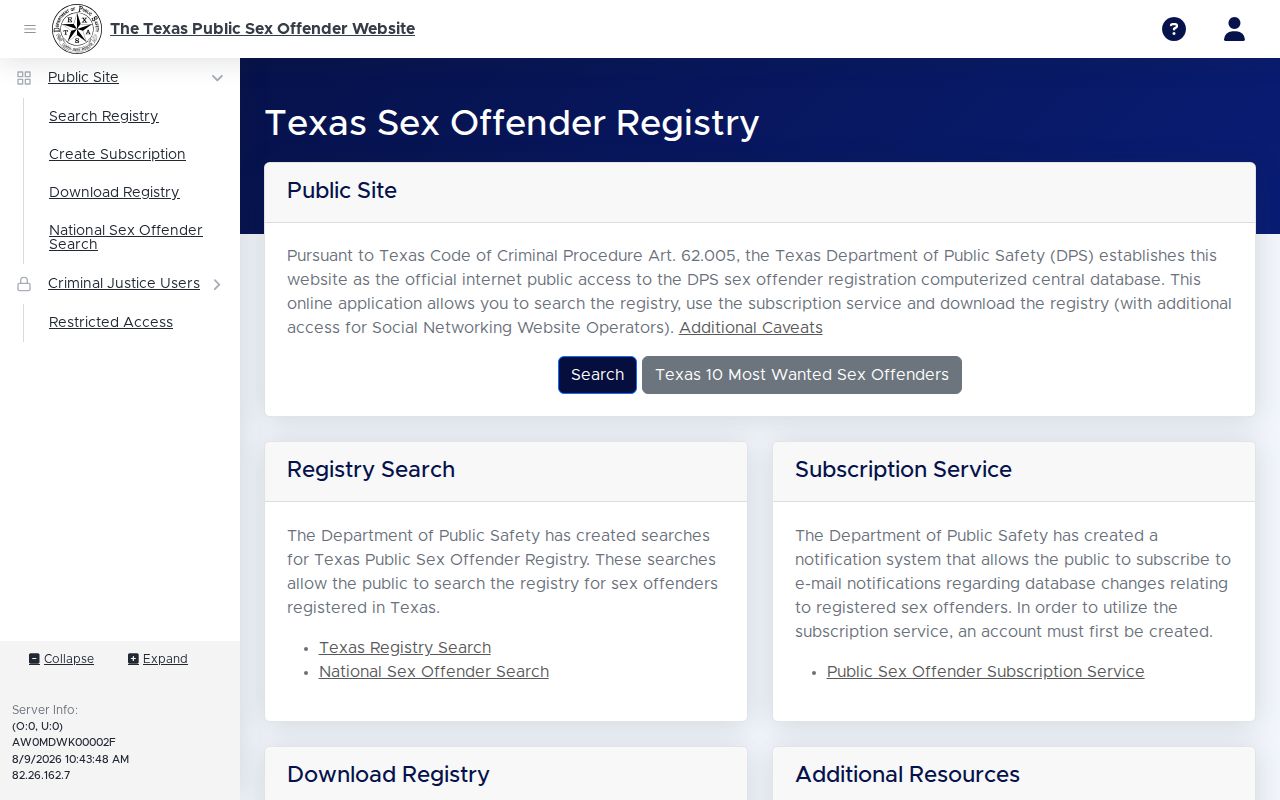
Because live controls can change, follow the labels displayed by DPS and avoid third-party copies of registry data.
Crane County Registry Map Limits
A map pin is not a rating for a home, road, block, or part of Crane County. It represents registry location data within the map's display and geocoding limits. An address may have changed after the last agency update. Rural descriptions can also be less neat than a city street point. Check the written profile and updater information instead of judging only the pin.
Texas does not publish one universal statewide residency-distance rule. DPS says a general-law municipality may adopt a child-safety-zone ordinance within statutory limits and exemption procedures. Do not infer a distance rule from the map itself. The registry shows public registration facts, while local ordinances and supervision terms are separate sources.
If a Crane County registry address seems stale, do not confront the person or household. Note the profile and updating agency, then contact Crane Police for an entry inside the city or the Crane County Sheriff's Office for a county entry. DPS Sex Offender Registration can be reached at 512-424-2800 or SOR.Training@dps.texas.gov for state-program questions.
Registry Profiles: What They Show
A public Crane County registry profile combines identity, offense, location, and registration facts that DPS is allowed to release. It is not a full criminal-history file. Texas registration collects more data than the public sees, and some fields remain protected. Review all public fields together before deciding that a returned record matches the person or place searched.
| Name and aliases | Reported identity names used to distinguish the registrant. |
|---|---|
| Photo and description | Photo plus public physical traits such as sex, race, height, weight, eyes, and hair. |
| Registered location | Public address or geographic location information allowed by law. |
| Offense facts | Reportable offense, victim age, conviction date, and punishment information. |
| Risk level | Texas assessment of danger and the chance of continued criminal sexual conduct. |
| Registration status | Public compliance and update information supplied through the registration system. |
Public exceptions include Social Security and driver-license numbers, phone numbers, online identifiers, victim-identifying data, and court-protected juvenile registration. A Crane County profile also cannot prove a person's current conduct or supply every court filing tied to the underlying case.
Correcting Crane County Registry Entries
A person reviewing their own Crane County registration entry should start with the profile's most recent updating agency. Gather the relevant certified records before asking for a change. When a duty may have expired, Texas directs the registrant to supply a certified charging instrument, judgment or adjudication, and proof of discharge for each possible registrable offense.
The local agency checks complete Texas and national dispositions, any duty from another jurisdiction, and any current supervision condition before calculating removal. This is not a delete button in the public portal. A court outcome, discharge date, and registration rule must align. DPS maintains the statewide system, but the agency responsible for the latest update is the practical first stop.
The DPS registry FAQ gives the official risk, duration, verification, and public-field explanations.
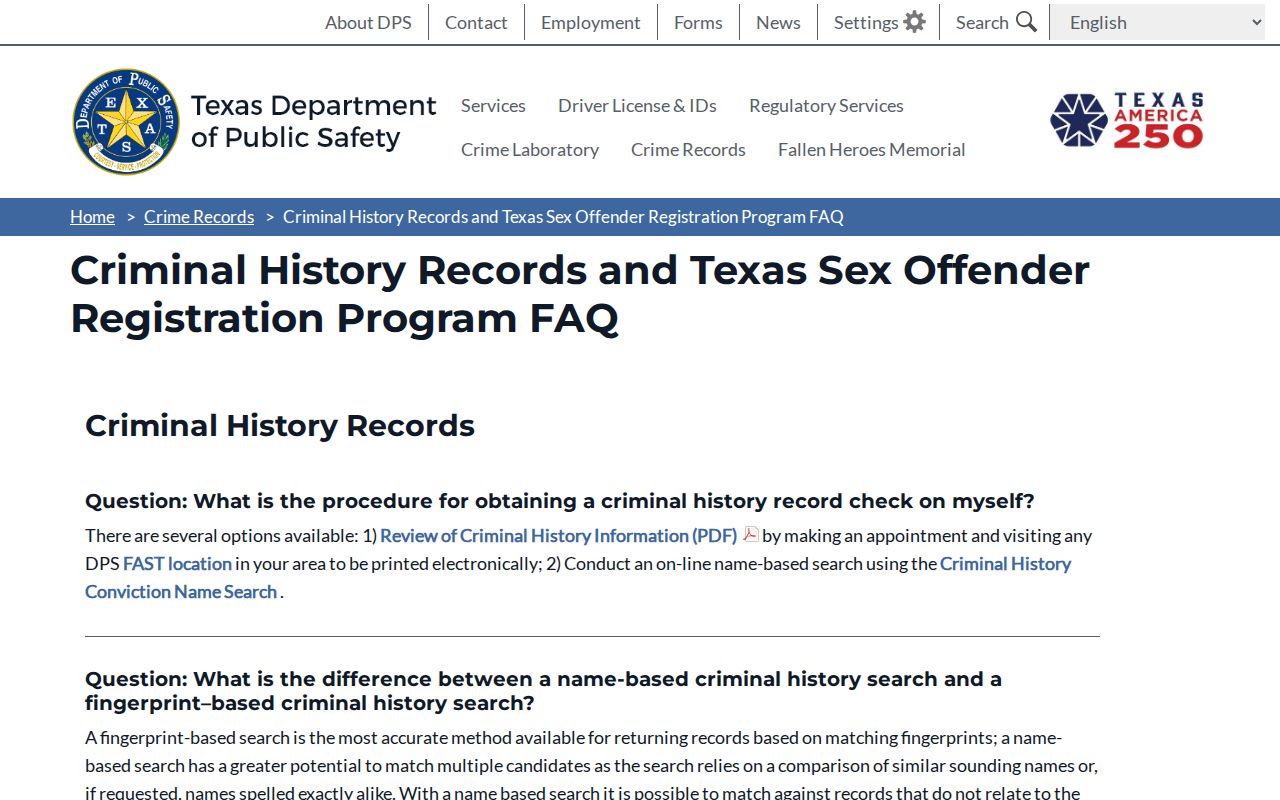
Those rules help separate a true data issue from a lawful registration duty that remains active.
Note: Use certified case and discharge records when asking the responsible agency to recalculate a Crane County registration duty.
Registration Levels and Duties in Texas
Texas numeric risk levels describe assessed danger. They are not federal SORNA tiers, and they do not set how long a person registers. Level one means low danger and an unlikely chance of further criminal sexual conduct. Level two means moderate danger and a chance the conduct may continue. Level three means serious danger and a likely chance it will continue.
| Category | Duration | Verification frequency |
|---|---|---|
| Risk level 1, 2, or 3 | Not set by risk level | Not set by risk level alone |
| Adult registration duty | Life or 10 years after discharge, based on offense and statute | Usually annual unless another statutory category applies |
| Two or more sexually violent offenses | Offense-based duty | Every 90 days |
| Civilly committed sexually violent predator | Offense and order based | Every 30 days |
For most other registrants, verification is annual. Adults register for life or ten years after discharge from incarceration, parole, or community supervision, depending on the offense and statutory facts. Juveniles may ask a juvenile court for exemption or nonpublic status. A Crane County registry profile should therefore be read with risk, duration, and verification treated as three separate concepts.
The official Code of Criminal Procedure Chapter 62 is the controlling registration source.
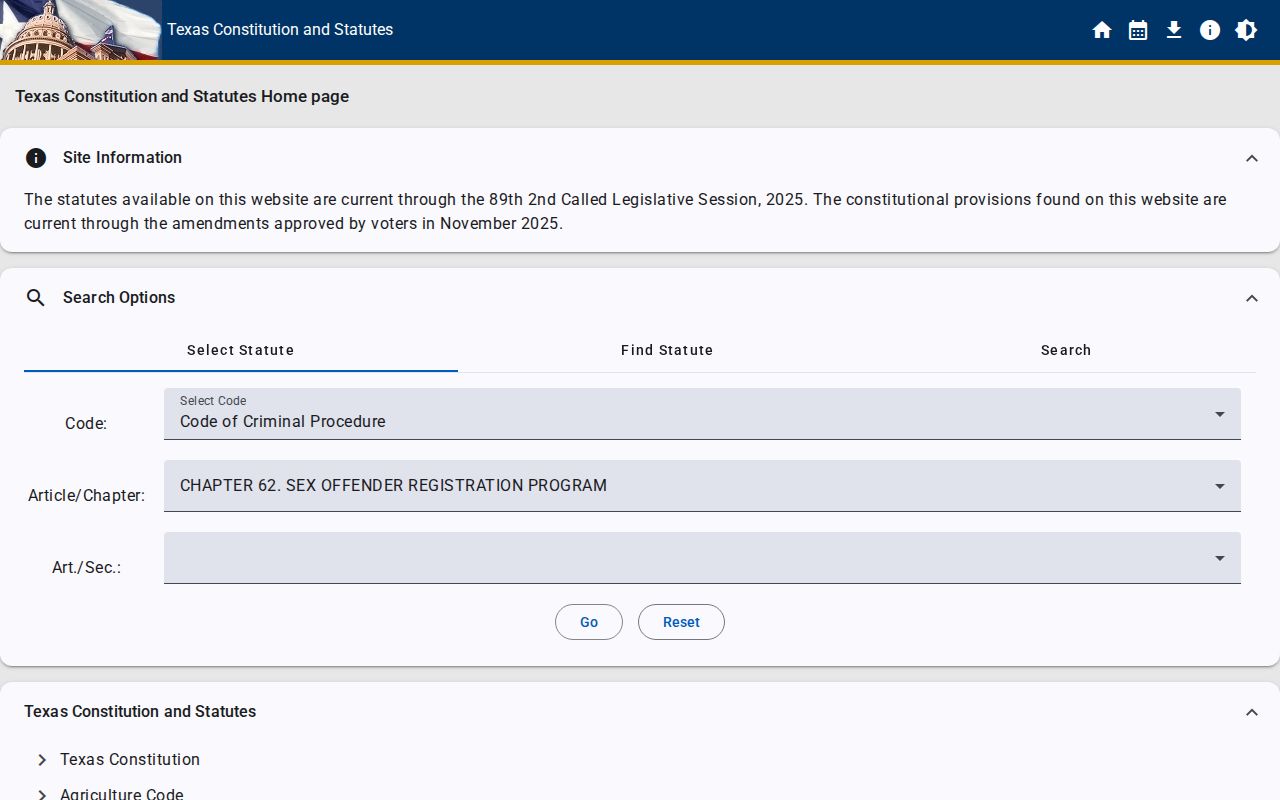
Chapter 62 explains why offense type, not the displayed numeric risk level, controls the length of the duty.
Crane County Registry Address Duties
Address rules matter in a county with one city and a large rural area. A registrant who plans to move within Texas must report the intended change in person by the seventh day before moving. The person must then report to the new local authority by the seventh day after arrival with proof of identity and residence. A move across the Crane city line can change which local authority handles the entry.
A person leaving Texas reports before departure and registers in the destination jurisdiction by the tenth day after arrival. Texas also requires added reporting when a person spends more than 48 consecutive hours on at least three occasions in one month in another Texas municipality or county. These are registration duties, not public map search tips. The public should report a suspected stale entry through official channels and let the responsible agency verify compliance.
Crane County and National Registry Search
DPS, local law enforcement, and the U.S. Department of Justice serve different roles. DPS runs the Texas public database. Crane Police or the Crane County Sheriff's Office maintains the local registration and supplies updates based on municipal boundaries. The National Sex Offender Public Website, or NSOPW, searches participating public registries across jurisdictions and is useful when a person or address connection may cross a state line.
Use the Texas profile for the state's detailed entry and updater. Use NSOPW as a cross-state supplement, not as a replacement for the Crane County agency that owns the local update. A result may reflect the timing and public rules of the source jurisdiction. Search names carefully and compare identifying details rather than relying on one broad match.
The official National Sex Offender Public Website provides that wider public layer.
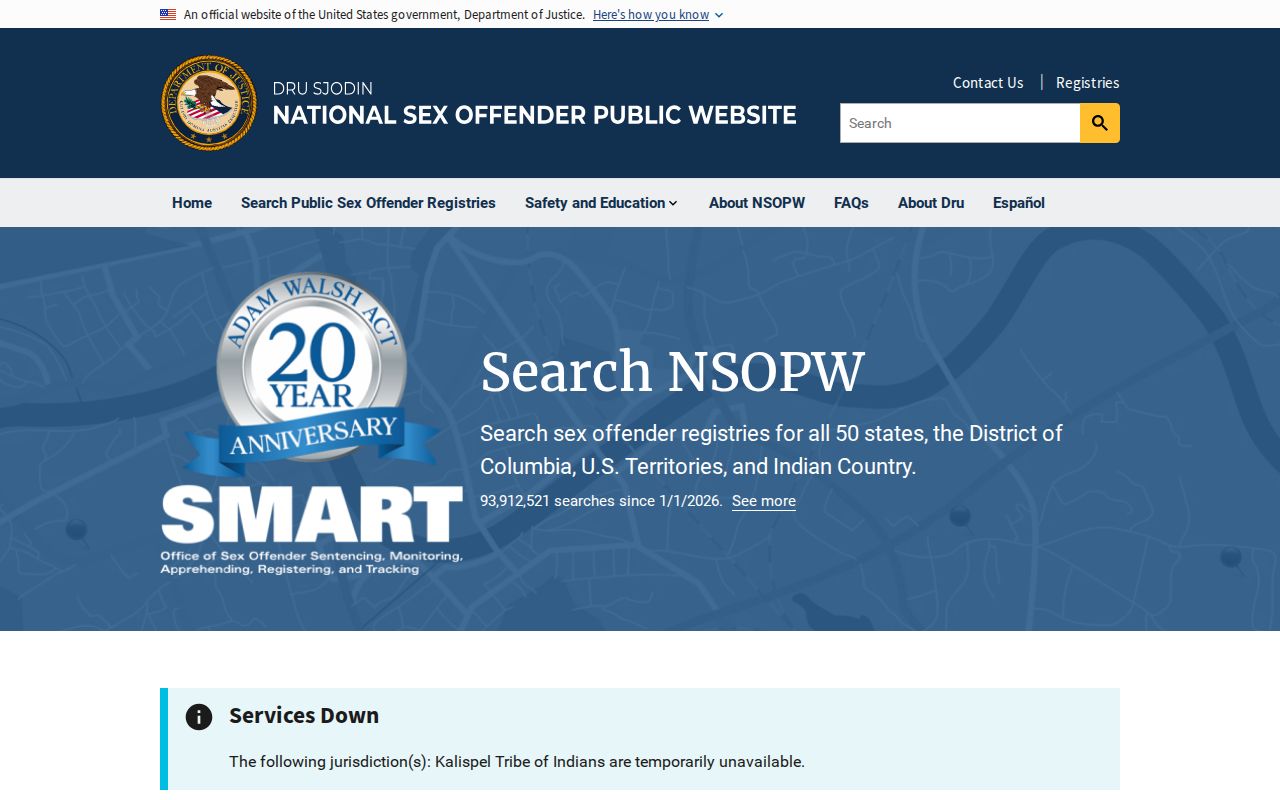
Pairing NSOPW with the Texas entry helps when travel, a move, or an old address reaches beyond Crane County.
Using Registry Information Lawfully
Registry data supports personal, family, and community safety awareness. Use it to verify a location, understand an official notice, plan a talk with family members, or review one's own public entry. It is not permission to confront, follow, threaten, shame, or punish a registrant or anyone in the household. A map location also does not measure present behavior or risk at a specific property.
Texas sends added community notices for high-risk and civilly committed persons. DPS describes postcards in English and Spanish within one mile in unsubdivided areas or three blocks in subdivided areas, with post-office boxes excluded. This formal notice process is separate from rumor, social media, or private action.
Registry misuse warning: Do not use Texas registry information to harass, threaten, or intimidate a registrant or household. Misuse may lead to criminal prosecution under Texas law; Chapter 62 governs the registry and public notice.
When a Crane County entry looks wrong, preserve the profile details and call the agency shown as the updater. Report facts. Do not investigate the person on your own. Local law enforcement and DPS can compare the entry with the registration file and court documents.